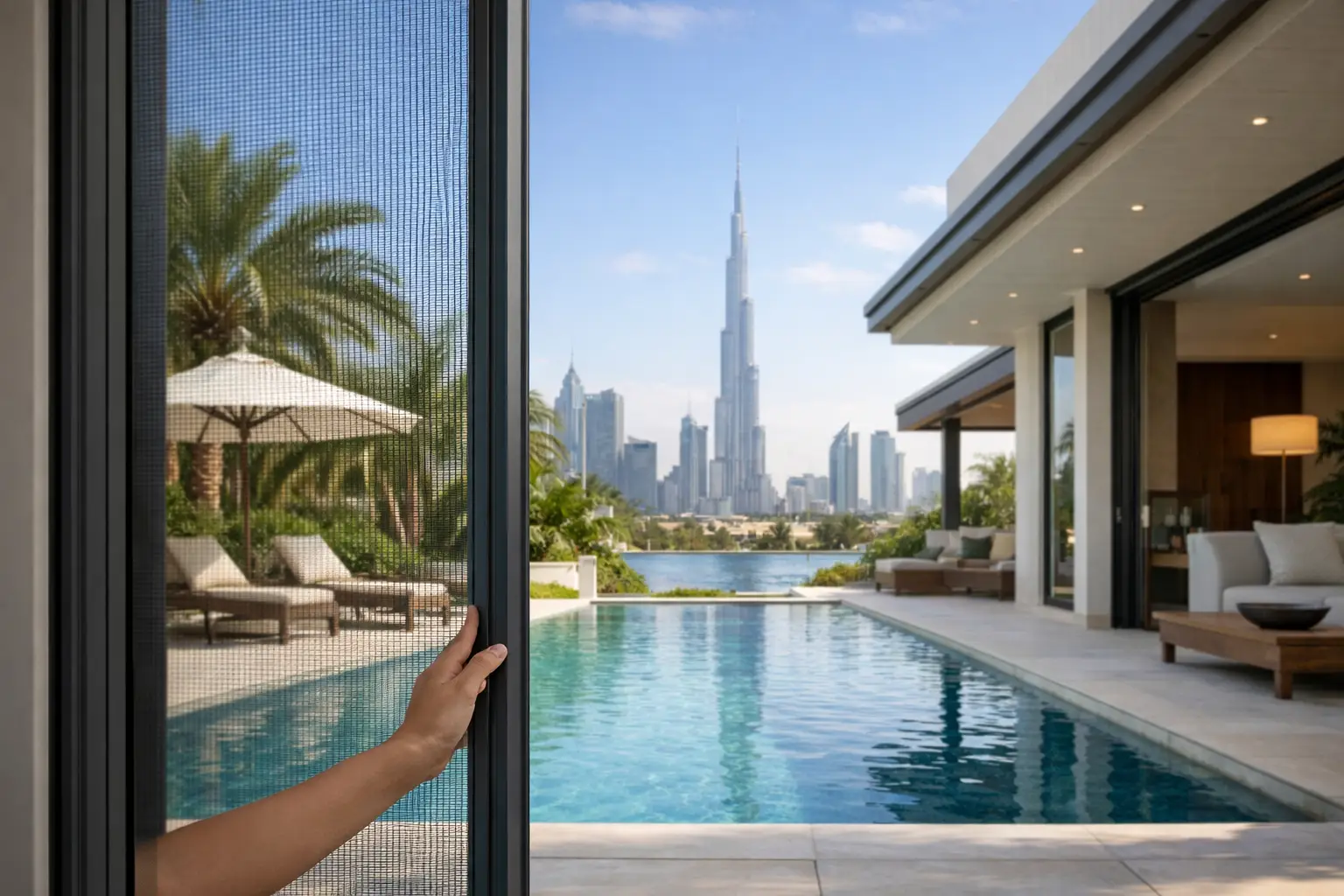
An open balcony door can make a Dubai home feel brighter, breezier, and more connected to its surroundings. It can also invite mosquitoes and other insects inside within minutes. The right fly screens solve that practical problem without making a carefully designed window, terrace door, or kitchen opening look like an afterthought.
For villas, apartments, and refined commercial spaces, screening should be considered part of the architectural finish. Frame color, mesh clarity, opening style, and installation detail all influence whether the result feels discreet and polished or visibly added on.
Why Fly Screens Matter in Dubai Interiors
Dubai residents often keep doors and windows closed while air conditioning is running. Still, there are many moments when natural ventilation is welcome: early mornings, cooler evenings, balcony gatherings, and the mildest months of the year. Screens allow occupants to enjoy those moments with more confidence, especially in homes near landscaped areas, water features, or outdoor dining spaces where insects are more common.
They also help make indoor-outdoor living more usable. A large sliding door is designed to frame a view, bring in daylight, and extend the living area toward a terrace. A poorly chosen screen can interrupt all three. A well-planned one preserves the visual rhythm of the opening while providing a useful barrier when the door is open.
It is worth setting realistic expectations. Standard insect mesh is not a substitute for sealed glazing, air filtration, or dust control. Fine dust can still enter through an open screened opening, particularly on windy days. The benefit is insect protection and improved usability, not a fully sealed environment.
Choosing Fly Screens for Each Opening
The best system depends on the window or door operation, the available frame depth, how frequently the opening is used, and the desired interior aesthetic. One style rarely suits an entire property.
Fixed screens for low-access windows
Fixed screens work well on windows that are opened mainly for ventilation rather than as an access point. They are simple, stable, and often the most visually restrained option. The frame can be color-matched to aluminum window profiles so it reads as part of the original assembly.
Their limitation is access. Cleaning the exterior glass or mesh may require removing the screen, so this should be planned carefully for upper-floor windows and difficult-to-reach elevations.
Sliding screens for terraces and balconies
Sliding systems are a natural choice for sliding glass doors. They move along a track and are suitable for wide openings, provided the track layout is coordinated correctly. This approach is particularly effective in apartments where balconies function as an extension of the lounge or dining area.
The quality of the rollers and track matters. A screen that drags, rattles, or catches at the threshold quickly undermines the experience of an otherwise premium space. Smooth operation is as much a part of luxury as the visible finish.
Retractable screens for uninterrupted views
Retractable screens are designed to disappear into a slim cassette when not in use. They are ideal where the view, glazing, or door profile should remain visually uninterrupted, such as a contemporary villa with full-height openings or a hospitality-inspired living room.
They cost more than basic fixed options and require accurate installation. However, their discreet appearance can justify the investment in spaces where visual calm and flexibility are priorities.
Hinged screens for service doors and kitchens
Hinged screens suit single doors leading to gardens, utility areas, or secondary kitchens. They are easy to understand and practical for frequent access. Magnetic or self-closing details can be useful, but they should be selected for durability rather than convenience alone.
In busy homes, consider how the screen will perform when children, staff, pets, groceries, and outdoor furniture are moving through the doorway. The most elegant option is not always the most appropriate one for a high-traffic opening.
Details That Keep Screens Looking Refined
Mesh is not a minor specification. Darker mesh generally offers clearer outward views because it reduces glare and visual reflection, while lighter mesh can appear more noticeable against glazing. Fine mesh offers enhanced insect protection but may reduce airflow slightly compared with a more open weave. The right balance depends on the location and how the room is used.
Frame finish deserves equal attention. White or bronze frames may work with standard window systems, but custom powder-coated colors can better align with charcoal aluminum, warm timber tones, or a softer contemporary palette. The goal is not to make the screen a feature. It is to make it belong.
Installation must also protect the architecture. Clean junctions, properly aligned tracks, secure fixings, and carefully planned handles prevent a technically useful addition from compromising a bespoke joinery detail or a newly renovated façade. During a full fit-out or renovation, screen requirements should be reviewed alongside window treatments, door hardware, balcony thresholds, and glazing specifications, not after handover.
Plan Screens Before the Final Handover
Retrofitting is possible, but early planning gives you more choice and a cleaner result. A design-and-build team can assess each opening before furniture, curtains, blinds, and custom joinery are finalized. This avoids common conflicts, such as a retractable screen cassette competing with a curtain recess or a sliding panel obstructing a preferred furniture layout.
For commercial settings, screens should be selected with operational flow in mind. A café terrace, reception area with operable doors, or staff kitchen needs a solution that stands up to repeated use while maintaining a professional appearance.
Aakruti Technical Services Co. approaches these details as part of the complete environment, where vision meets craftsmanship and practical performance. When fly screens are specified early, they protect the comfort of a space while allowing its light, views, and design language to remain fully present.
Before selecting a system, stand at each open window and door at the time you are most likely to use it. That simple check reveals whether the priority is airflow, a clear view, easy access, stronger insect protection, or a screen that disappears when the day is done.