
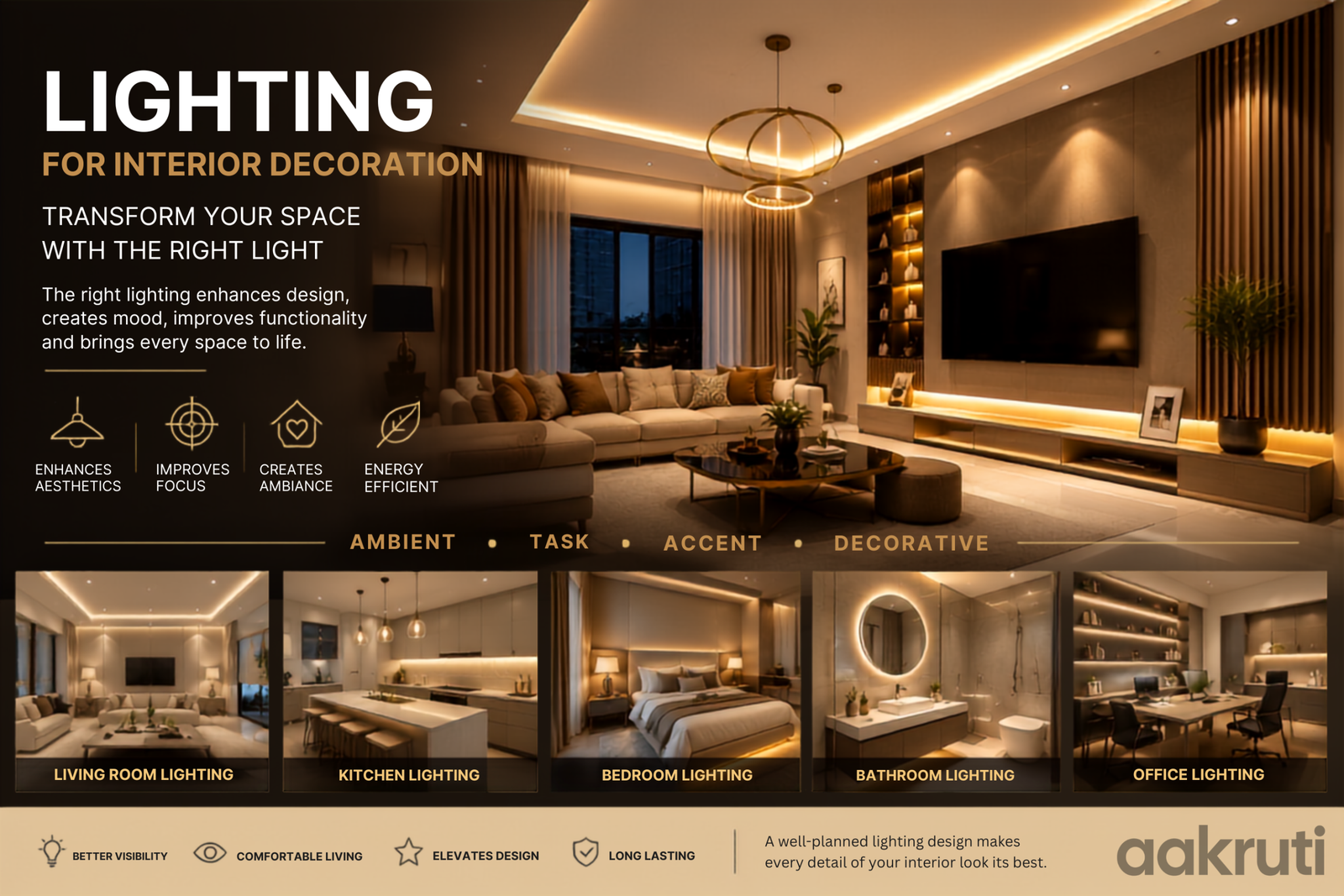
When you walk into a well-designed home in Dubai, you immediately sense the difference between lighting that has been merely installed and lighting that has been thoughtfully planned. The distinction is not just visual—it is deeply emotional. Lighting acts as the “invisible designer,” shaping how we feel, influencing our mood, and defining the atmosphere that turns a house into a sanctuary.
At Aakruti Technical Services Co, we understand that great interior decoration goes far beyond furniture and paint. Based in Dubai, we are a versatile service provider offering high-quality technical, maintenance, and contracting solutions across residential, commercial, and industrial sectors. From electrical system upgrades and MEP services to renovation and refurbishment works, our team of skilled technicians and engineers work with precision to bring your interior vision to life.
In this guide, we explore everything you need to know about lighting for interior decoration in Dubai—from the fundamental principles of layered lighting to the trends shaping homes in 2026.
Why Lighting Matters in Interior Decoration
Lighting is the single most transformative element in any interior, yet it is consistently the most underinvested and poorly planned aspect of homes. The typical developer handover in Dubai includes basic recessed downlights on a single switch circuit—no layered lighting, no dimming, no accent lighting, no task lighting. The result? Interiors that feel flat and institutional, regardless of how much is spent on furniture and finishes.
A thoughtful lighting design, by contrast, creates depth, atmosphere, and visual hierarchy that makes every other design element look better. In Dubai’s unique environment, where natural light creates a stark contrast between scorching outdoor heat and cool, climate-controlled interiors, artificial lighting becomes especially critical.
The Three Layers of Lighting
Good lighting design is not about buying expensive fixtures. It is about understanding the three layers of light and how they work together.
1. Ambient Lighting (General Illumination)
Ambient lighting provides the base level of illumination that allows you to move through a space safely and see clearly. In most Dubai properties, this is the only type of lighting provided—ceiling-mounted downlights that create a uniform wash of light.
The problem with ambient lighting alone is that it flattens everything, creating no shadows, no highlights, and no visual interest. Ambient lighting should be controllable (dimmable) so you can adjust the overall brightness to suit different activities and times of day.
For residential spaces, plan for approximately one downlight per 1.5 to 2 square metres.
2. Task Lighting
Task lighting provides concentrated illumination for specific activities: reading, cooking, working, grooming, and hobbies. Without task lighting, you either flood the room with ambient light (creating glare and wasting energy) or strain your eyes.
Key task lighting applications include:
-
Kitchen countertop under-cabinet lights (essential for food preparation)
-
Desk lamps or overhead directional lights in home offices
-
Vanity lighting in bathrooms (positioned at face level on either side of the mirror—never overhead, which creates unflattering shadows)
-
Bedside reading lights (wall-mounted or table lamps with adjustable direction)
-
Dining table pendant lights (hung 70 to 80cm above the table surface)
3. Accent and Decorative Lighting
Accent lighting creates visual interest by highlighting architectural features, artwork, display shelves, or textured surfaces. It adds depth and drama to a space, making it feel designed rather than merely illuminated.
Common accent lighting includes:
-
Picture lights over artwork
-
LED strip lighting under floating shelves or behind headboards
-
Cove lighting in dropped ceiling details
-
Track lights highlighting feature walls
-
Uplights washing walls or columns with light
Decorative lighting—including chandeliers, pendant lights, and statement floor lamps—serves as both a light source and a design object, adding personality and visual anchoring to a room.
Dubai Lighting Trends in 2026
Dubai’s most sophisticated homeowners are moving away from harsh overhead glare. Instead, they are embracing lighting as fundamental infrastructure—a blend of cutting-edge technology, architectural precision, and wellness-focused design.
Trend 1: Layered Lighting
Layered lighting in Dubai homes dramatically improves both the lived experience and the visual appeal of a space. Modern homes use recessed lights, wall sconces, floor lamps, and hidden LEDs to create depth.
Living rooms in 2026 typically use three or four light sources simultaneously: warm, diffused ceiling light (dimmable), task lighting (floor lamp or table lamp), and accent lighting (wall sconces or under-cabinet lighting). This approach replaces the single, harsh overhead fixture that apartments typically come with.
Trend 2: Natural Materials
In 2026, lighting in Dubai is confidently moving toward natural materials rather than chrome and glass. Rattan, banana fiber, seashells, wood, and cotton are setting the trend in Dubai’s luxury lighting.
Rattan and woven pendant lights are among the most popular styles in Dubai interiors right now, fitting perfectly into boho, natural, and Scandinavian styles. Seashell chandeliers are the strongest trend in modern chandeliers in Dubai—they capture and reflect light differently than any other material, glowing in the afternoon sunlight and creating a warm, atmospheric play of light in the evening.
Trend 3: Sculptural Pendants as Art
Pendant lights are increasingly viewed as crafted objects that contribute to the mood, structure, and atmosphere of a space. In 2026, fixtures are treated as art—whether it is a sculptural pendant or a minimalist linear beam, the fixture itself becomes a design focal point.
Trend 4: Smart Lighting Integration
Lighting is no longer static. It is programmable, allowing scenes that shift with the time of day or activity. New luxury villas in Dubai incorporate app-controlled dimming, voice activation, and “tunable white” light that adjusts color temperature automatically.
Smart controls allow a single space to transition from a productive workspace during the day to a calming retreat at night.
Trend 5: Facade Lighting
In 2026, the exterior night-time appearance of a villa is just as important as its daytime architecture. Facade lighting transforms homes into luminous landmarks using targeted techniques like grazing (uplights positioned close to stone walls to highlight texture) and tracing (narrow beams that trace columns, cornices, and architectural lines).
Practical Lighting Tips for Every Room
Living Room
The living room is where layered lighting truly shines. Use a combination of:
-
A dimmable ceiling light for general illumination
-
Floor lamps in reading corners to create soft pools of light
-
Table lamps on side tables for intimate warmth
-
Wall sconces or picture lights to highlight artwork and architectural features
Kitchen
Kitchens require a balance of function and feeling. Focus on:
-
Task lighting under cabinets for food preparation (essential)
-
Ambient lighting from recessed downlights for general visibility
-
Accent lighting to highlight the kitchen island or feature backsplash
-
Use neutral white (3500K–4000K) for task areas where you need clear visibility
Bedroom
Bedrooms should feel soft, layered, and relaxing. Consider:
-
Dimmable ceiling lights for overall illumination
-
Bedside table lamps or wall sconces for reading (avoid overhead lighting that creates unflattering shadows)
-
Warm colour temperatures (2700K–3000K) that promote relaxation and melatonin production
-
LED strip lighting behind the headboard for a subtle, modern glow
Dining Room
The dining room benefits from a statement focal point:
-
Hang a pendant or chandelier 30–36 inches above the table for standard ceilings
-
Use warm white bulbs (2700–3000K) to make food look appetizing and create a convivial atmosphere
-
Add wall sconces or candles for additional warmth and depth
Bathroom
Bathroom lighting should be both functional and flattering:
-
Position vanity lighting at face level on either side of the mirror—never overhead
-
Combine downlights with sidelights for balanced illumination
-
Consider dimmers for a spa-like experience
Understanding Colour Temperature
Colour temperature, measured in Kelvin (K), determines the warmth or coolness of the light:
-
2700K – Warm white, like candlelight. Ideal for bedrooms and living areas.
-
3000K – Warm white, like halogen. Great for dining rooms and general living spaces.
-
4000K – Neutral white, like daylight. Suitable for kitchens and home offices.
-
5000K+ – Cool white/daylight, like a hospital. Best avoided in residential settings.
For residential spaces in Dubai, 2700K to 3000K is generally recommended to create warm, inviting interiors.
LED Technology: What You Need to Know
LED lighting has completely replaced halogen and fluorescent in the UAE market. When choosing LEDs, remember:
-
Lumens (not watts) measure brightness. A 60W incandescent equivalent produces approximately 800 lumens, achievable with an 8-10W LED.
-
Colour temperature determines the feel of the light (see above).
-
LED strips are excellent for under-cabinet lighting, cove lighting, and highlighting architectural features.
-
Energy efficiency is now mandatory, with trends including motion-sensing automation and solar-assisted systems.
Common Lighting Mistakes to Avoid
-
Relying on a single overhead light source – This creates flat, shadowless spaces with no visual interest.
-
Using overly bright, harsh lighting – Especially in living and dining areas.
-
Forgetting dimmers – Dimmers are a practical and energy-efficient way to quickly change the feel and warmth of an area.
-
Ignoring task lighting – Without it, you either flood the room with ambient light or strain your eyes.
-
Poor placement of bathroom lighting – Overhead lighting creates unflattering shadows on the face.
How Aakruti Technical Services Can Help
At Aakruti Technical Services Co, we bring your interior decoration vision to life with professional electrical and lighting solutions. Our services include:
-
Electrical system upgrades – Ensuring your lighting design is supported by safe, reliable electrical infrastructure
-
Renovation and refurbishment – Transforming existing spaces with modern lighting schemes
-
MEP services – Comprehensive mechanical, electrical, and plumbing solutions for residential and commercial projects
-
HVAC installation and maintenance – Creating comfortable, well-lit environments
Our team of skilled technicians and engineers work with precision, ensuring every project—whether a minor repair or a large-scale installation—is executed seamlessly. With a customer-focused approach, we provide timely service and reliable support tailored to your requirements.
Conclusion
Lighting is the foundation of great interior decoration. It creates mood, defines spaces, and elevates every other design element. In Dubai’s unique environment, thoughtful lighting design is not a luxury—it is essential.
Whether you are renovating a villa, upgrading an apartment, or designing a commercial space, Aakruti Technical Services Co is your trusted partner for professional electrical and lighting solutions. Contact us today to discuss how we can help illuminate your space.



Customer Reviews
[…] Natural light is often the most powerful starting point. Sheer curtains, carefully positioned mirrors, and open sightlines can distribute daylight more effectively without compromising privacy. In Dubai, however, more daylight is not always better. Strong direct sun can create glare, heat gain, and fading finishes. The better solution may be filtered light through textured drapery, solar-control glazing, timber screens, or deep window treatments that soften the experience of the sun. […]