
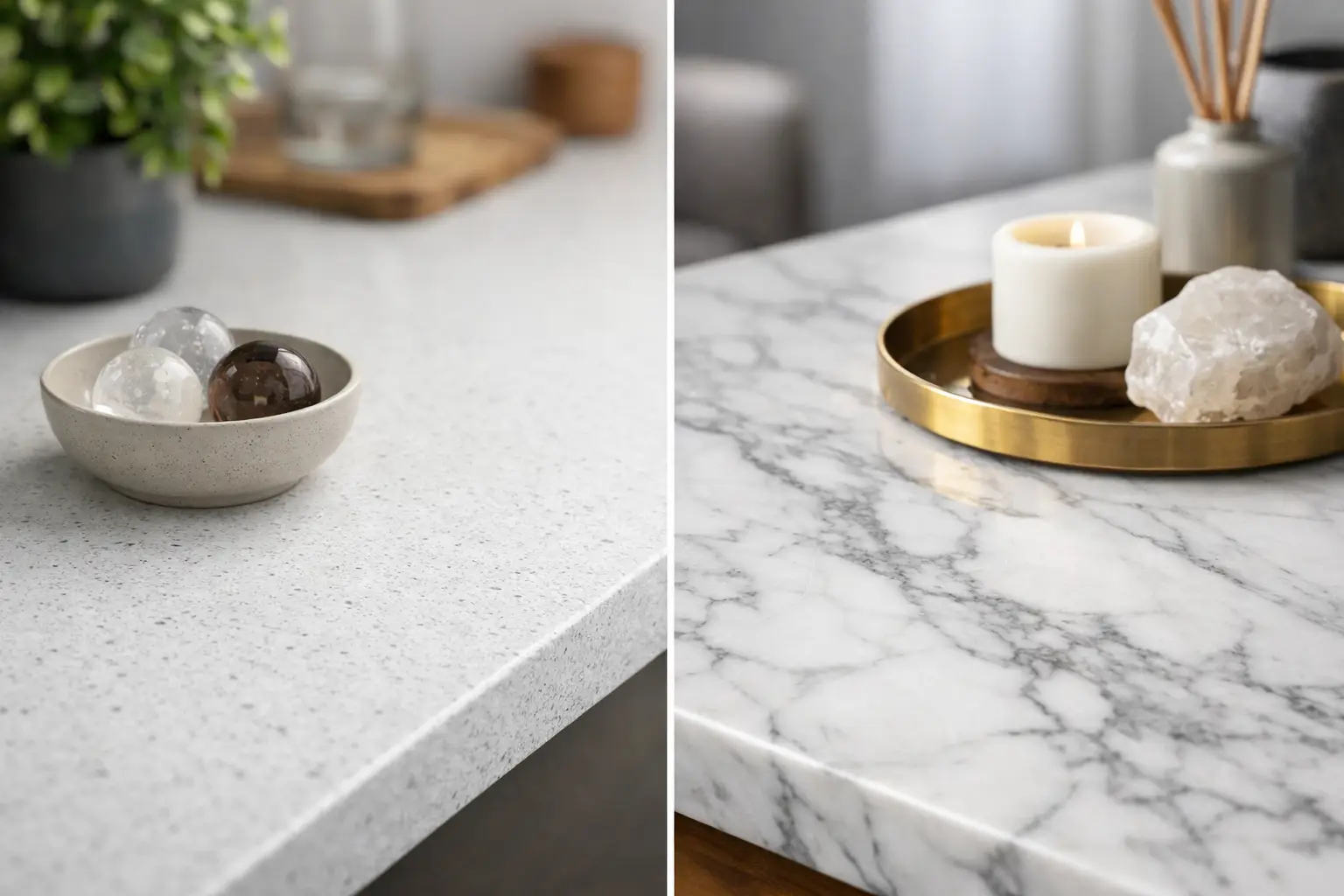
A kitchen island is often the first surface people touch, photograph, and gather around. That makes the quartz versus marble decision far more personal than a specification sheet. One material offers composed consistency and everyday confidence; the other brings natural movement, depth, and a patina that evolves with the home. The right choice depends on how you live, how you want the room to feel, and how much care you want the surface to require.
For a polished Dubai residence, villa, boutique office, or hospitality setting, both can become part of a living work of art. The difference lies in pairing material character with real-world use from the very beginning of the design process.
Quartz Versus Marble at a Glance
Quartz countertops are engineered surfaces made from crushed natural quartz combined with resins and pigments. They are manufactured in slabs, which gives designers greater control over color, pattern, and consistency. A marble-look quartz can create a refined, light-filled kitchen without the variability of a natural stone slab.
Marble is a natural stone, formed over time and cut directly from the earth. Every slab has its own veining, mineral variations, and shifts in tone. That individuality is its great strength. No printed pattern can fully recreate the soft translucence and organic depth of genuine marble.
Neither is automatically the more luxurious choice. Luxury comes from selecting the right material for the setting, detailing it beautifully, and executing every joint, edge, and transition with precision.
Choose Quartz for Effortless Daily Performance
Quartz earns its place in hardworking kitchens, family homes, rental properties, and commercial areas because it is nonporous. It does not usually need sealing, and it is highly resistant to common stains from coffee, cooking oils, cosmetics, and juice. For clients who want a crisp, premium finish without adding stone-care rituals to their routine, this is a meaningful advantage.
Its visual consistency is equally valuable in larger projects. When an island, backsplash, vanity, window ledge, and custom joinery detail need to read as one intentional composition, engineered slabs make matching easier. This is especially useful in contemporary interiors where clean lines, book-matched panels, and controlled tonal palettes define the design.
Quartz is also available in a broad range of looks, from warm limestone-inspired finishes to dramatic, marble-like veining. The best designs do not treat it as an imitation. Instead, they use quartz for what it does well: delivering a calm, tailored surface with reliable performance.
There are limits. Quartz is not invincible against heat. A hot pan placed directly on the surface can damage the resin binding the material, so trivets remain essential in the kitchen. Strong sunlight can also affect some quartz products over time, making it a less suitable choice for exposed outdoor countertops or areas with relentless direct UV without a product-specific suitability check.
Choose Marble When Character Matters Most
Marble changes the atmosphere of a room. In a quiet powder room, a dramatic entrance, a fireplace surround, or a statement island, its veining can give the space a sense of permanence that few materials match. It is especially compelling when the stone is selected slab by slab and positioned to make the natural movement feel intentional.
For homeowners drawn to classic European elegance, contemporary minimalism with warmth, or richly layered hospitality interiors, marble offers visual depth that rewards close attention. Honed marble has a soft, matte elegance; polished marble reflects light and makes its color variation more pronounced. Both can feel exceptional when paired with considered lighting and bespoke joinery.
The trade-off is care. Marble is porous and contains calcium carbonate, which can react with acidic ingredients such as lemon, vinegar, wine, and tomato. This reaction creates etching – a dull mark that changes the finish rather than simply sitting on the surface like a stain. Sealing helps reduce absorption, but it does not make marble immune to etching.
That does not mean marble is impractical. It means it suits clients who appreciate natural materials as they age. In a low-traffic bathroom vanity, formal dining setting, reception desk, or feature wall, the maintenance is generally manageable. In a busy family kitchen where citrus, spices, and quick cleanups are daily realities, some owners will find its evolving patina charming while others will find it stressful. Knowing which group you belong to is more useful than following a trend.
The Kitchen Is Usually the Deciding Room
A kitchen should be designed around behavior, not only appearance. If the island will host schoolwork, meal prep, entertaining, and regular cooking, quartz is often the more relaxed choice. Its stain resistance and straightforward cleaning support a kitchen that looks composed even during a busy week.
Marble can still work beautifully in kitchens, particularly on a baking station, a decorative island, or a secondary serving area. Bakers often value its naturally cool surface. The key is honest planning: use marble because you love its character, not because you expect it to perform exactly like an engineered material.
A thoughtful hybrid approach can offer the best of both worlds. Quartz may be used across main worktops and the back run, while marble takes center stage on an island, bar counter, or sculptural backsplash. Done well, the combination creates contrast without making the room feel fragmented. Consistent undertones, edge profiles, and hardware finishes bring the composition together.
Bathrooms, Offices, and Feature Areas Need Different Answers
Bathrooms place fewer demands on countertops than kitchens, which makes marble a strong candidate for vanity tops, wall cladding, niches, and ledges. It brings a spa-like quality that is difficult to replicate, particularly when its veins continue across adjacent surfaces. Good ventilation, appropriate sealing, and careful cleaning products help preserve the finish.
Quartz is excellent for family bathrooms and high-use guest suites, where toothpaste, makeup, hair products, and frequent cleaning call for an uncomplicated surface. Its uniformity can also support a crisp, architectural look in compact bathrooms where visual calm matters.
In commercial interiors, the decision is often guided by brand expression and traffic. Quartz suits reception counters, pantry areas, healthcare-adjacent spaces, and work surfaces that must remain polished under heavy use. Marble makes a memorable impression in executive reception areas, luxury retail, restaurants, and hospitality spaces where material storytelling is part of the experience.
Cost Is More Than the Slab Price
Comparing only the price per square foot can lead to surprises. The total installed cost depends on slab selection, thickness, fabrication complexity, cutouts, edge details, backsplash height, transport, installation access, and the number of seams required. A simple quartz countertop may be more economical than premium marble, but a high-design quartz slab with waterfall sides and detailed fabrication can move into a very different budget category.
Marble pricing varies substantially by origin, rarity, grade, and slab character. Two stones with a similar base color can have very different costs because one has more dramatic veining, larger usable areas, or limited availability. Natural stone also requires careful inspection before fabrication. The exact slab you approve matters, especially if veining needs to flow across an island face or book-matched wall.
A clear specification early in the project protects the budget. It should cover the chosen slab, finish, thickness, edge profile, sealing requirements, backsplash detail, and any visible joints. This is where integrated design and technical coordination save time: a beautiful material decision must still work with cabinetry tolerances, appliance clearances, plumbing points, and lighting.
How to Make the Final Choice
Start with a few direct questions. Do you want the surface to remain visually consistent, or do you want it to gain character over time? Will it face daily cooking, children, guests, or heavy commercial use? Are you comfortable using coasters, trivets, and pH-neutral cleaners? Finally, does the slab support the wider interior palette rather than compete with it?
View full slabs whenever possible, not only small samples. A sample may show color, but it cannot reveal the scale of a marble vein or the repetition within a quartz pattern. Stand back, assess the slab in the intended lighting, and decide where seams and cutouts will land. The most successful surfaces are planned as part of the entire room, not selected in isolation.
At Aakruti Technical Services Co., material choices are considered alongside design direction, bespoke joinery, technical detailing, and implementation. That helps turn a beautiful sample into a finished surface that performs as confidently as it looks.
Choose quartz when you want refined ease. Choose marble when you want nature’s unmistakable signature and are ready to let it live with you. The surface beneath your hands should support the way you use your space while making every arrival feel considered.