
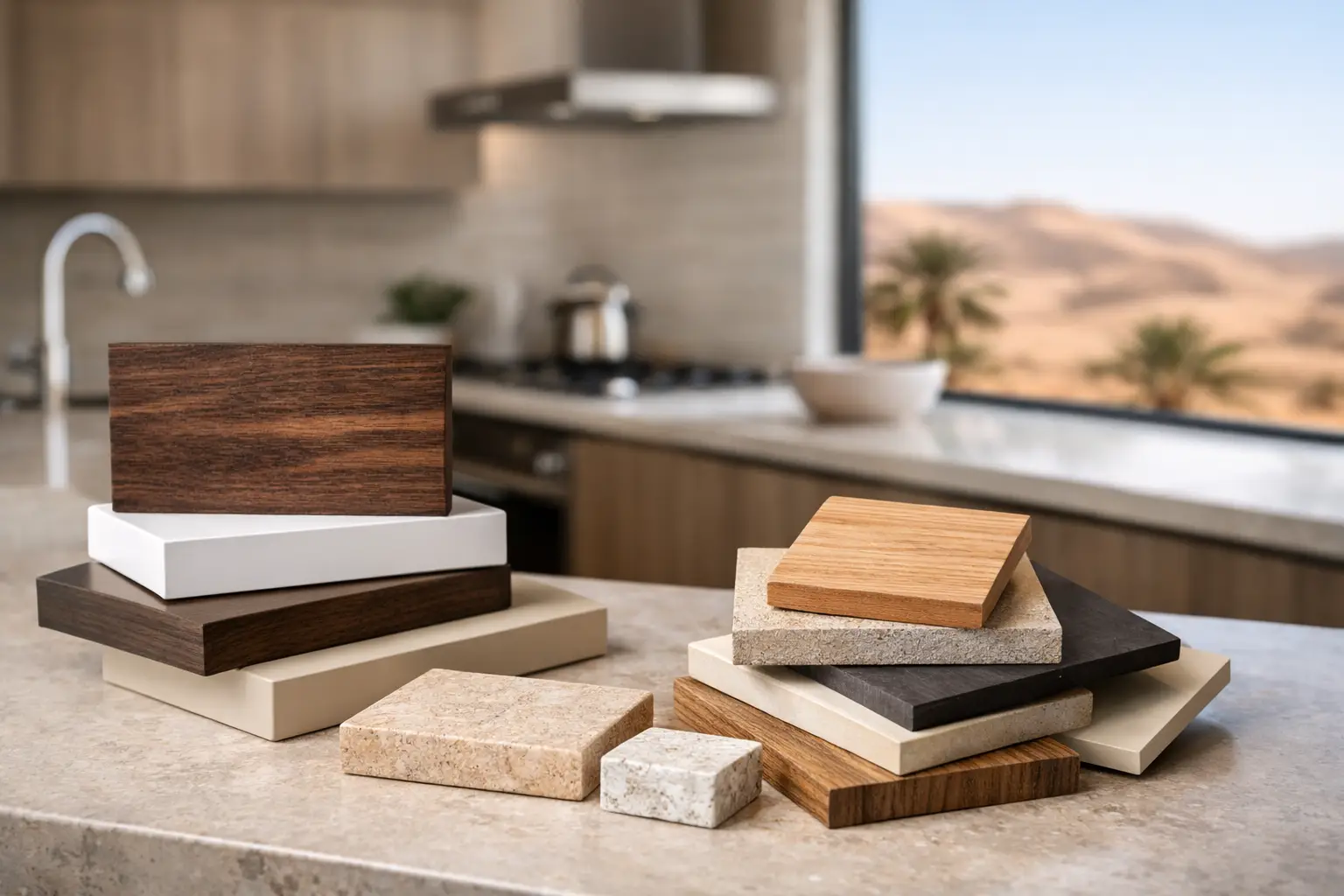
A beautiful kitchen can lose its polish quickly when cabinet materials are chosen for a mild climate rather than the UAE’s heat, humidity, and intensive daily use. The Best Materials for Kitchen Cabinets in the UAE Climate are not simply the most expensive options. They are the materials that keep their shape, finish, and function through steam, air-conditioning cycles, spills, and years of opening and closing.
For a Dubai villa, an apartment kitchen, or an investment property, the right cabinet construction protects both the design vision and the value of the renovation. It also makes daily life easier: doors stay aligned, drawers glide properly, surfaces wipe clean, and the kitchen continues to feel considered long after handover.
What the UAE Climate Demands From Kitchen Cabinets
The UAE’s climate creates a specific set of pressures inside the home. Outdoor heat is intense for much of the year, while interiors are heavily air-conditioned. This repeated shift between warm, humid conditions and cool, dry rooms can cause lower-grade board materials to expand, contract, or lose their edge integrity over time.
Kitchens add another layer of stress. Steam from cooking, moisture around the sink and dishwasher, oil residue, and frequent cleaning products all affect cabinet boxes, shutters, and finishes differently. A material that looks exceptional in a showroom may not be the right choice if its core swells after a small plumbing leak or if its finish chips around high-use handles.
That is why cabinet selection should start beneath the surface. The visible finish matters, but the board core, edge treatment, hardware, ventilation planning, and installation quality determine how well the kitchen performs.
Marine Plywood: The Premium All-Rounder
For many high-quality UAE kitchen projects, marine plywood is the most dependable cabinet carcass material. It is made from layers of hardwood veneer bonded with moisture-resistant adhesive, giving it greater strength and stability than standard plywood or particleboard.
Marine plywood is particularly well suited to under-sink units, dishwasher surrounds, and cabinet boxes near plumbing. It holds screws securely, supports heavier stone countertops well, and is less likely to sag under the weight of full pull-out drawers and pantry systems. When finished with quality laminate, veneer, lacquer, or acrylic fronts, it supports almost any luxury kitchen style.
Its trade-off is cost. Genuine marine-grade plywood is more expensive than MDF and particleboard, and quality varies between suppliers. A cabinet should not be labeled “marine plywood” without confirming the actual grade, thickness, and edge-sealing method. Even a moisture-resistant core needs carefully sealed cutouts around sinks, pipes, and appliance connections.
For homeowners who want a tailored kitchen with long-term confidence, marine plywood is usually worth the investment where it matters most.
MDF: Best for Painted and Sculpted Cabinet Fronts
Medium-density fiberboard, commonly called MDF, has an exceptionally smooth and uniform surface. That makes it a strong choice for painted cabinet doors, routed shaker profiles, fluted details, curved elements, and other refined joinery features. It does not have the grain movement associated with natural timber, so the painted finish can appear especially clean and consistent.
In a climate-controlled UAE home, high-density moisture-resistant MDF can perform well for upper cabinets, decorative panels, and doors away from direct water exposure. It is also a practical material for achieving a sophisticated lacquered kitchen without the price of solid timber doors.
However, MDF is not the best material for every location. If water enters an unprotected edge or joint, standard MDF can swell and become permanently damaged. The area under the sink is its greatest risk point. For this reason, it is wiser to pair MDF fronts with marine plywood cabinet boxes in wet zones rather than building the entire kitchen from MDF.
The finish is equally important. A professionally applied polyurethane or lacquer coating, with proper sealing on all sides and edges, gives MDF a far better chance of retaining its beauty through everyday use.
HMR Board: A Practical Middle Ground
High Moisture Resistant board, often referred to as HMR board, is engineered to offer better resistance to humidity than standard MDF. It is commonly identified by its green core, although color alone should never be treated as proof of quality.
HMR can be a sensible option for internal cabinet components, dry-area carcasses, and painted or laminated shutters when budget and performance need to be balanced. It offers a smoother surface than plywood for certain finishes and is generally more resistant to moisture than regular MDF.
Still, “moisture resistant” does not mean waterproof. HMR board should not be treated as an automatic substitute for marine plywood around sinks, dishwashers, or utility areas. Its durability depends on the board specification, the laminate or paint system, sealed edges, and whether water is allowed to sit against it.
For a carefully planned kitchen, HMR board can reduce costs without compromising the overall result, provided it is placed in the right parts of the design.
Aluminum: The Smart Choice for Wet and High-Use Zones
Aluminum cabinets have become increasingly popular in UAE kitchens, especially in modern apartments, outdoor kitchens, utility rooms, and homes where moisture resistance is the top priority. Aluminum does not swell, rot, or attract termites. It is also lightweight, easy to clean, and highly suited to humid conditions.
Its visual language is more contemporary than traditional. Powder-coated aluminum, glass-front combinations, and slim framed profiles can create an elegant, architectural look. It works especially well in kitchens designed around dark finishes, clean lines, integrated lighting, and large-format stone surfaces.
The limitation is warmth. Aluminum does not naturally provide the tactile richness of timber veneer or the soft tailored character of painted joinery. It can also dent under a sharp impact, and lower-quality fabrication may produce rattling doors or visible joint lines. The result depends heavily on profile thickness, fabrication accuracy, hinges, and installation.
A hybrid kitchen often delivers the best of both worlds: aluminum in high-moisture or service areas, with premium plywood and finished fronts in the main kitchen space.
Why Particleboard Is Usually a Short-Term Saving
Particleboard, sometimes called chipboard, is made from wood particles bonded into a sheet. It is affordable and widely used in mass-market cabinet systems, particularly when covered with laminate or melamine. In dry, low-use applications, it can be serviceable.
For a luxury kitchen in the UAE, though, it is usually the material to approach with caution. Its screw-holding strength is lower than plywood, its edges are vulnerable, and water exposure can cause swelling that cannot be reversed. A small leak beneath a sink or a repeated splash near a dishwasher can turn an apparently economical choice into a replacement project.
Particleboard may be acceptable for removable internal shelving in a dry pantry or for budget-led rental upgrades, but it should not be the default foundation for a kitchen intended to last. The savings are often felt only at the beginning, while the compromises appear later.
The Finish Matters as Much as the Core
Cabinet materials are only part of the decision. The finish determines how the kitchen looks in natural light, how easily fingerprints show, and how well doors stand up to everyday cleaning.
High-pressure laminate is one of the most practical choices for busy households. It is available in wood, stone, matte, textured, and solid-color looks, and quality laminates offer good scratch and stain resistance. Matte anti-fingerprint finishes are particularly effective for families and frequently used kitchens, where glossy surfaces may need constant wiping.
Acrylic creates a striking, high-gloss appearance and gives modern kitchens a crisp, reflective finish. It can make compact kitchens feel brighter, though it requires care to avoid visible scratches. PU lacquer offers the most design freedom, with custom colors and a premium painted look, but it requires skilled application and thoughtful maintenance.
Natural veneer brings genuine warmth and variation, making it ideal for a kitchen designed as a living work of art. Because it is a natural surface, it should be properly sealed and protected from prolonged moisture and harsh cleaners. It is best for clients who appreciate authentic character rather than a perfectly uniform pattern.
Cabinet Details That Protect Your Investment
A high-grade board can still fail if the construction details are poor. Look for full edge sealing, moisture-resistant adhesive, durable back panels, and properly finished cutouts around pipes and appliances. Under-sink cabinets deserve special attention: a waterproof base tray, sealed interior surfaces, and accessible plumbing can prevent a minor leak from becoming major damage.
Hardware should match the quality of the cabinetry. Soft-close hinges and drawer runners from established hardware systems improve both the user experience and long-term alignment. Full-extension drawers, adjustable hinges, and correctly sized lift-up mechanisms make a tailored kitchen feel effortless to use while reducing strain on the cabinet structure.
Ventilation also matters. Heat-generating appliances need suitable clearances, and built-in dishwashers should be installed with the right protective detailing. These technical decisions are rarely visible in a finished kitchen, but they are central to a result that remains polished year after year.
Choosing the Right Material Mix for Your Kitchen
There is no single perfect material for every cabinet. The best specification often combines materials according to how each zone will be used. Marine plywood is an excellent choice for base cabinets, sink units, and heavy-duty storage. Moisture-resistant MDF or HMR board can suit painted fronts and dry cabinetry. Aluminum may be the strongest solution for utility spaces or particularly wet areas.
The final choice should reflect the property, cooking habits, finish preference, and expected ownership period. A family villa with daily cooking needs a different level of durability than a lightly used holiday apartment. Likewise, a rental property may prioritize durable laminate faces and easily replaceable components, while a forever home may justify veneer, custom lacquer, and more intricate bespoke joinery.
At Aakruti, material selection is considered alongside space planning, appliance integration, lighting, and installation details, so the finished kitchen is designed to perform as beautifully as it looks. Before approving a cabinet proposal, ask to see physical material samples, inspect edge treatments, and clarify exactly what will be used inside wet zones. Those quiet technical choices are what allow a remarkable kitchen to stay remarkable.




Customer Reviews
[…] are addressed before they become visible problems. That does not mean every decision is easy. Premium materials may involve longer lead times. A custom feature can require a higher investment than an […]